ChatGPT for HOA Documents: What Works and What Doesn't
If you serve on an HOA board, you've probably already tried it. You opened ChatGPT, pasted a question about your community's fence rules or pet policy, and waited for an answer. It's a natural impulse — ChatGPT is genuinely impressive at explaining things in plain English. But somewhere between the confident-sounding response and the homeowner standing at the board meeting asking "where does it say that?" — you realized the answer wasn't quite right.
You're not alone. This is the single most common story we hear from board members who find SayWhat. They tried the general-purpose tool first. It helped in some ways and failed in others. Here's a specific, honest breakdown of both.
What ChatGPT actually does well
Give credit where it's due. ChatGPT is a powerful general-purpose language model, and there are HOA-adjacent tasks where it genuinely shines.
Explaining general concepts. Ask ChatGPT "what are CC&Rs?" or "what's the difference between bylaws and rules & regulations?" and you'll get a clear, well-organized explanation. For board members who are new to governance terminology, this is legitimately useful.
Drafting communications. Need a first draft of a violation notice, a meeting agenda, or an email to homeowners about an upcoming assessment increase? ChatGPT produces solid starting points. You'll want to edit for your community's tone and specifics, but the structure and language are usually good.
Explaining legal terminology. HOA documents are full of phrases like "covenant running with the land" and "right of first refusal." ChatGPT translates these into plain English better than most glossaries.
These are real, valuable capabilities. If you're using ChatGPT for any of the above, keep doing it.
Where ChatGPT fails for HOA documents
The problems start when you ask ChatGPT a question that requires knowledge of your community's specific governing documents. This is where general-purpose AI and HOA governance fundamentally diverge.
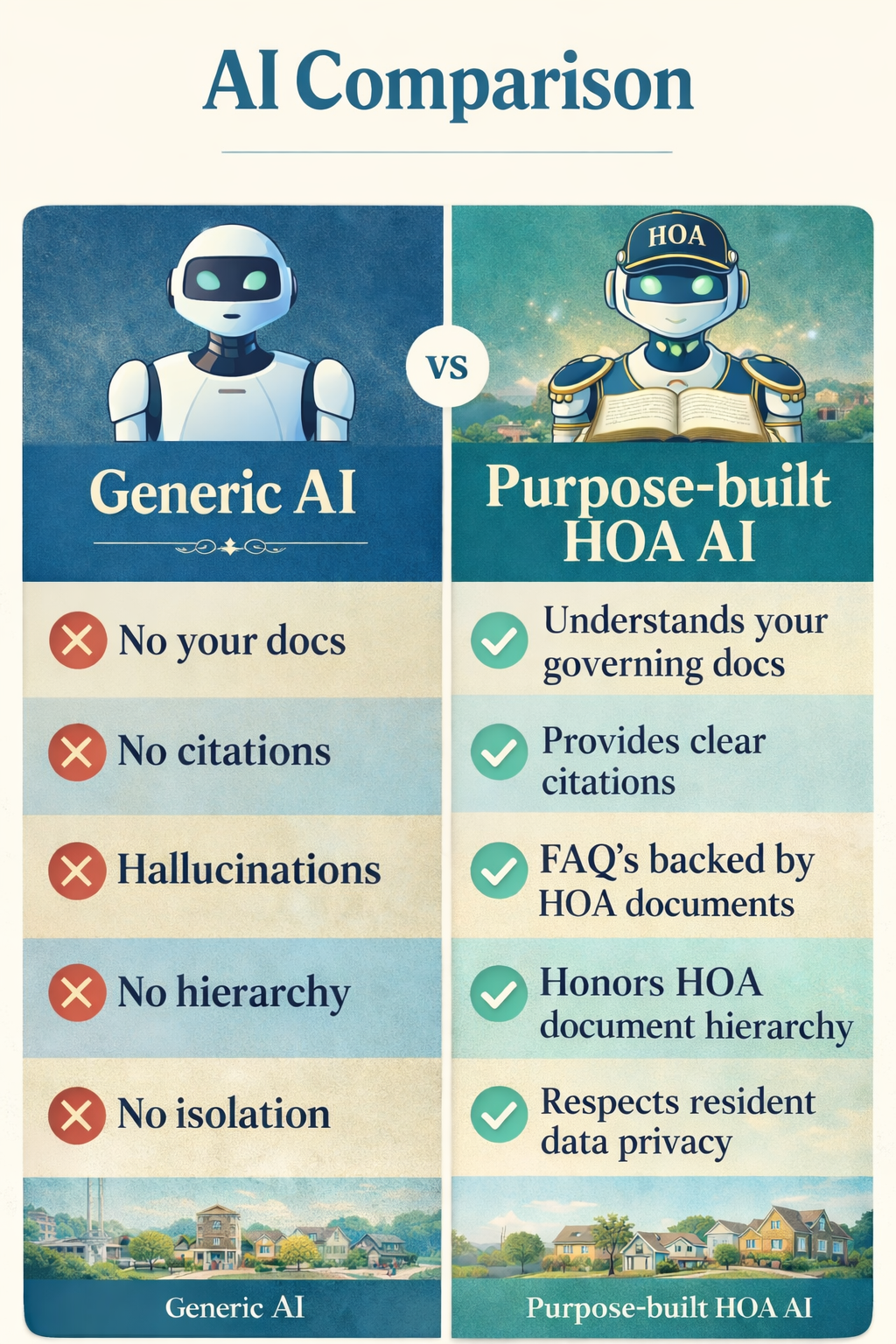
1. It doesn't have your documents
This is the most important point and the one most people overlook. ChatGPT knows about HOA governance in general. It has read thousands of articles, legal summaries, and forum posts about how HOAs work. It does not know what your CC&Rs say.
When you ask "can I build a fence in my community?" ChatGPT will give you a generic answer based on common HOA patterns — check with your ARC, review your CC&Rs, typical height limits are six feet. What it cannot tell you is that your CC&Rs, in Section 4.7, prohibit chain-link fencing on corner lots and require a 24-inch setback from the property line. That's the answer the homeowner actually needs.
2. It can't cite sources
Even if you upload your CC&Rs to ChatGPT, it doesn't reliably tell you which page and section the answer came from. You might get "according to your documents, fences must be approved by the ARC" — but no page number, no section reference, no way to verify the claim without reading the entire document yourself.
This matters more in HOA governance than in most contexts. When a homeowner challenges a board decision, "the AI said so" is not a defensible position. "Section 7.3, page 42 of the CC&Rs, recorded with the county on March 15, 2019" is.
3. It hallucinates
ChatGPT sometimes generates plausible-sounding rules that don't exist in your documents. It might tell a homeowner that your community allows two pets per household when the actual limit is three — or that there's a 30-day cure period for violations when your CC&Rs specify 14 days.
In casual conversation, a hallucination is a minor inconvenience. In HOA governance, it's a liability risk. A board that acts on a fabricated rule about enforcement authority — sending a fine notice citing a provision that doesn't exist — can face legal consequences. A homeowner who relies on a hallucinated exception to build an unapproved structure faces the cost of tearing it down.
4. It doesn't understand document hierarchy
HOA communities are governed by a stack of documents: state statutes, CC&Rs, bylaws, and rules & regulations. These documents follow a strict hierarchy — when they conflict, the higher-ranking document prevails.
ChatGPT doesn't know that your CC&Rs override your rules & regulations. It doesn't know that a 2019 amendment to Section 8 supersedes the original 2004 language. It treats all text equally. When your rules say one thing and your CC&Rs say another, ChatGPT has no mechanism to resolve the conflict. It might cite the wrong one.
5. There's no tenant isolation
If you manage multiple communities — common for management companies and larger boards — ChatGPT provides no data separation between them. Upload Community A's CC&Rs in one conversation and Community B's in another, and you're relying on conversation boundaries for isolation. There's no structural guarantee that one community's documents won't influence answers about another.
For a single-community board member, this might not matter. For a management company handling twelve communities, it's a real concern.
The "upload your PDF" workaround
Yes, ChatGPT lets you upload PDFs. This does help — the model can reference your actual document text instead of relying entirely on general knowledge. But the core problems remain.
You still get no reliable citations with page numbers. There's still no awareness of document hierarchy. And for a 100-page CC&R with amendments, there's no guarantee the model processed the entire document versus sampling portions of it. When a homeowner's question hinges on language buried on page 73, "sampling" isn't good enough.
The upload workaround turns ChatGPT from a general-knowledge tool into a slightly-better general-knowledge tool. It doesn't turn it into a document research tool.
What a purpose-built tool does differently
A system designed specifically for HOA document questions addresses each of these gaps directly:
- Your documents, indexed completely. Every page of every governing document is parsed, chunked, and embedded with page-level precision. Nothing is sampled or summarized away.
- Exact citations. Every answer includes the specific document name, section, and page number it came from. Board members can verify. Homeowners can look it up themselves.
- Tenant isolation by design. Community A's documents are structurally separated from Community B's. Not by conversation boundaries — by architecture. One community's data cannot leak into another's answers.
- Document hierarchy awareness. When an answer draws from multiple sources, the system knows which document ranks higher. A rule that conflicts with the CC&Rs gets flagged, not cited as authoritative.
- "I don't know" when the answer isn't there. A purpose-built system can recognize when the question isn't answered by the available documents and say so explicitly — instead of generating a plausible guess.
The honest answer
ChatGPT is a remarkable general-purpose tool. It's not a remarkable HOA document tool. That's not a criticism — it wasn't built for this use case.
The stakes in HOA governance are specific: enforcement actions, legal liability, homeowner trust, fiduciary duty. These stakes require answers that are specific to your community, cited to a source, and grounded in your actual documents. General knowledge, however articulate, doesn't meet that standard.
SayWhat was built specifically for this problem. We don't claim to do everything ChatGPT does — we do one thing well: answer questions from your community's governing documents with citations. Every answer traces back to a specific document, section, and page. When the answer isn't in the documents, the system says so.
Related reading
- How AI Should (and Shouldn't) Be Used in HOAs: where AI helps a board and where it should stay out.
- How to Read HOA Documents Without Losing Your Mind: how to read the documents yourself.
If you've tried ChatGPT for your HOA documents and found the answers too generic, too uncitable, or occasionally wrong — that's exactly the problem SayWhat was built to solve. Every answer comes from your documents, with the exact section and page number. See the difference.
← Back to Blog